
Read this blog post in: Português
The Vanzas are part of the social fabric of Diu and traditionally worked as weavers. Historically, this social group initiated the prosperous textile trade from India to East Africa, which sustained the economic activity of Diu for several centuries. They revere Hinglaj Mata, a Hindu goddess whose main pilgrimage temple is located in what is now the Balochistan region of Pakistan.
Shri Vanza Gnati Diu possesses a group of individuals who dedicate their time, skills, and energy to the betterment of their society. These are the members of the community organisation who, through their various roles, unwavering commitment, collaborative spirit, and adaptability, create a lasting impact on the community. It is crucial to recognise and appreciate their invaluable contributions as they inspire others to become active participants in building a stronger, more compassionate, and inclusive society.
Over the centuries, the community has acquired real estate that has supported its functioning and development. These properties have provided spaces for community gatherings, leisure activities, cultural events, and artistic expression.
Real Estate Properties of Shri Vanza Gnati Diu
1. Hinglaj Mata Mandir
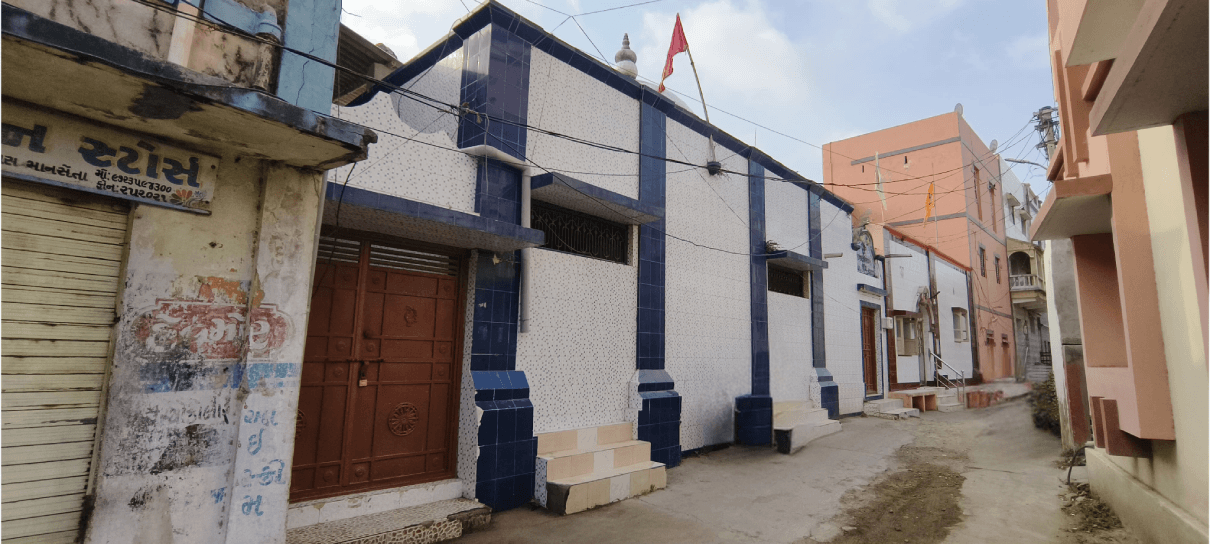
The Hinglaj Mata temple, located on the historic Beco Inglaje in the vibrant Zampa Neighbourhood, is a hub pulsating with devotion and culture. With great zeal and dedication, the local residents manage all of the activities of the temple, ensuring that ancient traditions remain alive and flourishing.
During the festival of Holi, the temple transforms into a sea of colours and joy. Devotees of all ages participate in the Holi Puja. Cheerful colours, devotional chants, traditional dances, and a united community in celebration make this time unforgettable.
Hinglaj Mata Mandir, exterior view. Photo courtesy of Kaushal Parekh.

Hinglaj Mata Mandir, interior view. Photo courtesy of Kaushal Parekh.
During the Navratri period, the temple takes on an aura of reverence and continuous celebration. For nine nights, the community gathers to honour the various forms of the goddess Durga. Garba and Dandiya Raas are danced with joy and enthusiasm, while traditional music resonates throughout the temple walls.
The community celebrates the festival of Dussehra with great devotion and fervour. During this special occasion, they perform a ritual known as Shami Puja, dedicated to the Shami tree, which is believed to possess divine powers and is a symbol of protection and good fortune in Hindu culture. On the morning of Dussehra, community members gather by the Shami tree at the Hinglaj Mata temple. They begin the ritual by decorating the tree with flowers, mango leaves, and garlands, and its surroundings with small ornaments and oil diyas, creating an auspicious atmosphere. During the puja, they make offerings of fruit, sweets, and traditional dishes to the tree, symbolising gratitude and devotion. After the ritual is completed, community members seek blessings from the tree to overcome obstacles, achieve success in their endeavours, and maintain peace in their lives, reflecting the community's deep desire to live in prosperity and harmony.

In this photograph, we can see members of the community gathered around the Shami tree at the Hinglaj Mata temple, preparing for Shami Puja. Photo courtesy of Uday Anantcumar Vaghela
In ancient times, Sharad Purnima was an event of unparalleled grandeur. In the heart of the temple, actors, musicians, and dancers, adorned in resplendent costumes, would perform ancient epics and legends. Tales of divine love, heroic battles, and mythological feats came to life under the moonlight, captivating the audience and immersing them in the storyline.
During Diwali, the temple is illuminated with thousands of diyas, symbolising the victory of light over darkness. Besides these grand festivals, various ceremonies and events are organised at the temple throughout the year, such as bhajan sandhya, and mamerun, among others.
2. Shri Hinglaj Mata Mandir - Prerna Dham
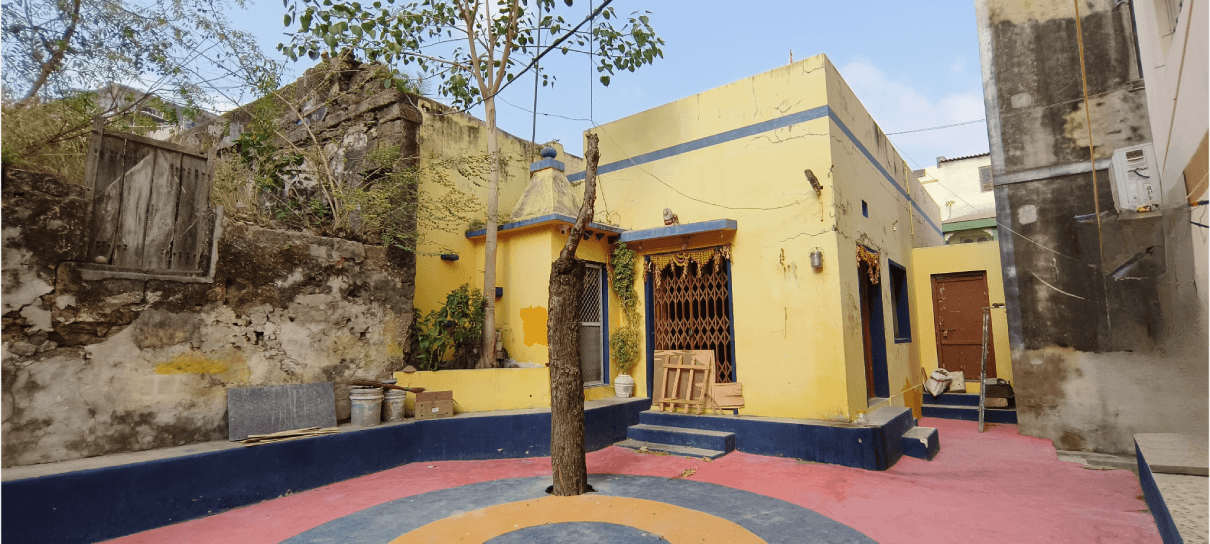
The Shri Hinglaj Mata temple, located on Kumbharvada Road (formerly Rua dos Oleiros), near the Shri Jalaram temple, possesses a hall named Prerna Dham dedicated to cultural festivities.
Shri Hinglaj Mata Mandir - Prerna Dham, exterior view. Photo courtesy of Kaushal Parekh.

Shri Hinglaj Mata Mandir, interior view. Photo courtesy of Kaushal Parekh
Dholo Aato is celebrated on Marghshirsh Shukla Ashtami and Marghshirsh Shukla Chaturdashi, when pauwa and kheer are offered to Hinglaj Mata in memory of the protection she granted the community against Parshuram.
Navratri, with its nine nights of devotion, is celebrated with Garba and Dandiya Raas. Men and women dance in a circle around the goddess Durga, their clothes shining under the festive lights, while traditional music echoes through the air, and the temple fills with chants and prayers. The devotion is deep, and each night culminates in an explosion of joy and gratitude.
During the Mamerun celebration dedicated to Hinglaj Mata, she is offered chunari, jewellery, and other adornments.
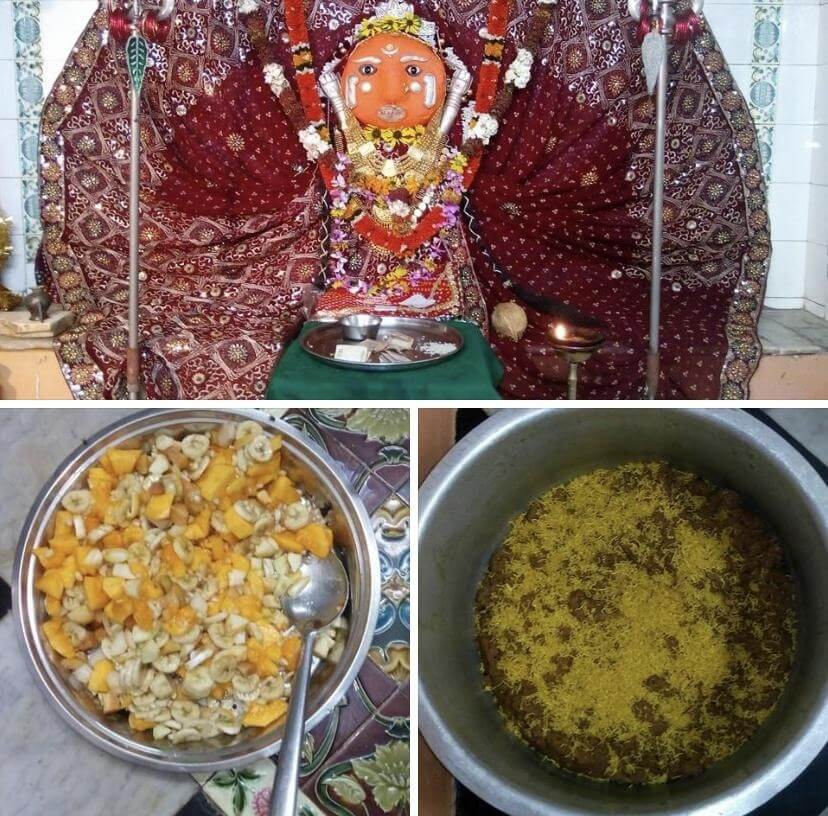
Mamerun celebration dedicated to Hinglaj Mata. Photos courtesy of Vijay Cumaldas.
Ujaani is an annual community festival, also celebrated in the Prerna Dham hall. Families gather early in the day to prepare delicious dishes, after which people are served by community volunteers. The feast begins with a collective thanksgiving for the opportunity for everyone to share this meal side by side, promoting the spirit of equality and camaraderie.

Shri Hinglaj Mata Mandir’s adjacent hall, Prerna Dham, interior view. Photo courtesy of Kaushal Parekh.
Every year, the academic achievements of the community’s students are celebrated, with awards being distributed to those who achieved first, second and third place at school. The Prerna Dham hall fills with pride, as relatives applaud enthusiastically. Not only is this event a tribute to individual effort, but it is also a recognition of the value of education and the community’s support in developing future generations.
Each of the temple’s activities reinforces cultural heritage and strengthens the community’s bond, enabling memories to be created that will be cherished for years to come.
3. Shri Vanza Gnati Gnan Pracharak Pustakalay
The Shri Vanza Gnati Gnan Pracharak library is located on Makata Road, directly opposite the Shri Vanza Gnati Yuvak Mandal. The library houses a remarkable collection of books, including some rarities.
In the past, the Shri Vanza Gnati Gyan Pracharak Pustakalay played a vital role in the intellectual and cultural life of the community, supported by a diverse membership and a strong network of dedicated volunteers. The library opened its doors at 8 p.m. and closed them promptly at 10 p.m., offering a tranquil two-hour sanctuary for reading and study. Despite this limited timeframe, it served as a welcoming and stimulating gathering place where community members came together to read newspapers and magazines and stay informed about world events. Young readers, in particular, made frequent use of the library’s lending services, borrowing books that nurtured their curiosity and broadened their horizons.

Shri Vanza Gnati Gnan Pracharak Pustakalay, exterior view. Photo courtesy of Kaushal Parekh.

Chopda Pujan at the Shri Vanza Gnati Gnan Pracharak Pustakalay.
On Diwali, community committee members gather at the library to perform Chopda Pujan amid the treasured books, upon a table adorned with diyas. With reverence, members open the sacred accounting ledgers to seek the blessings of Laxmi, the goddess of prosperity. That evening, surrounded by knowledge and devotion, they write new chapters of prosperity for the community, sealing their hopes for the future with faith and optimism.
4. Shri Vanza Gnati Yuvak Mandal
The Shri Vanza Gnati Yuvak Mandal, located on Makata Road near the Mahalaxmi temple, is a space dedicated to youth entertainment.

Shri Vanza Gnati Yuvak Mandal, exterior view. Photo courtesy of Kaushal Parekh.
The formerly vibrant and lively Yuvak Mandal was a sanctuary where young people developed skills, cultivated friendships, and forged everlasting memories. Afternoons in this hall echoed with the rhythmic sounds of ping pong balls against paddles, and the sliding of carrom pieces across tables. Meanwhile, games of checkers and chess being played provided mental stimulation. The youth would also cheerfully make their way to the field near the Shri Hinglaj Mata temple on Kumbharvada Road, where they would enjoy a game of volleyball.
5. Shri Vanza Gnati Prerna Bhuvan
The Shri Vanza Gnati Prerna Bhuvan is situated near the Shri Mata Totla Devi Mandir, in the heart of a historic neighbourhood. Its shops are currently rented at nominal rates, serving the local community. Every corner resonates with a harmony of past and present, where traditional architecture is enlivened by the vibrant energy of new occupants.

Shri Vanza Gnati Prerna Bhuvan, exterior view. Photo courtesy of Kaushal Parekh.
The Prerna Bhuvan served as a focal point of community life, where members regularly gathered to plan local initiatives and deliberate on matters of shared importance. In addition to its role as a meeting place, the Prerna Bhuvan also housed a collection of kitchen utensils that were highly valued by the community. These utensils were made available for hire, allowing families to use them during festivals and wedding ceremonies. This shared arrangement ensured that celebrations were supported with quality resources, fostering cooperation and unity while sparing individual families the burden of maintaining their own complete sets of utensils.
6. Shri Mata Totla Devi Mandir
The Shri Mata Totla Devi temple stands in Totla Devi Chowk and is reached by way of the historic Pitambar Alley. It was built on the initiative of Mithibai, wife of Shri Amarchande Raichande. This sacred site, a symbol of devotion and transcendent beauty, was inaugurated on the 7th of May, 1905, during the presidency of Shri Dullabhdas Narcim.
A few decades ago, the benefactors who provided financial support for both the interior and exterior renovation of the Shri Mata Totla Devi temple played a vital role in preserving this important cultural and religious heritage. Their generous contributions made possible a series of significant improvements. Inside the temple, new tiles were installed revitalising its appearance, while enhancing durability and ease of maintenance. Externally, the donations funded the restoration of the façade and surrounding structures, ensuring that the temple remained safe, welcoming, and structurally sound for devotees. Together, these renovations helped safeguard the temple’s architectural integrity while preserving its historical and cultural value for both present and future generations.


Shri Mata Totla Devi Mandir, exterior view. Photos courtesy of Vijay Cumaldas.
During the Mamerun celebration dedicated to Totla Devi, she is lovingly adorned with sacred offerings.
On Divaso, the square of the Shri Mata Totla Devi temple comes alive, marking a joyous celebration in honour of Saraswati, the goddess of knowledge, and the beginning of a new harvest. During Rakshabandhan, brothers and sisters exchange vows of love and protection, while on Kajli Teej, women welcome the monsoon season with prayers and dance, seeking blessings for their families and homes. On each of these festive occasions, community members gather in the temple square to perform Dandiya Raas, moving gracefully to the rhythmic melodies of Garba songs.

Mamerun celebration dedicated to Totla Devi.


List of benefactors, who contributed financially to the renovation of the Shri Mata Totla Devi Mandir, engraved on the temple tiles.

Community members gathered in the square of the Shri Mata Totla Devi Mandir on the auspicious occasion of Garba. At the heart of the image stands the majestic Garbo, elaborately adorned with intricate details, and symbolising divine feminine energy. Photo courtesy of Shri Hasmucrai Amarchande.
7. Shri Mateshwar Mahadev Mandir
The Shri Mateshwar Mahadev temple is located on Totla Devi Road, in the Bhoivada neighborhood.
This venerable temple, over five hundred years old, is accessed by descending the nineteen steps that lead to its sacred interior. Within the sanctum rest a Pothiadada, a turtle, and a majestic Shiva Linga. An idol of Parvatiji is enshrined in a gavaksh or gokh (a recess in the wall). Descending a further seventeen steps brings one to the sacred well, known as Matri Vav.


In these photographs, we can see the Pothiadada, the turtle, the Shiva Linga, the idol of Parvatiji, and the well named Matri Vav. Photos courtesy of Kaushal Parekh and Nitin Jasvantalal.
8. Shri Vanza Gnati Amarvadi Diu
Located outside Zampa on Naida Road, the Shri Vanza Gnati Amarvadi Diu is a recently constructed recreational and cultural building that hosts the majority of community events.
In 2007, Shri Duarchandas Emichande was unanimously elected President of Shri Vanza Gnati Diu, and Shri Tulcidas Lacmichande was elected Vice President. Serving until 2011, they provided dedicated leadership and played a key role in the community’s growth and development, while continuing the committee’s tradition of organising all community events and activities.
Prior to the construction of the Shri Vanza Gnati Amarwadi Diu, all major community events were held at the Prerna Dham facilities on Kumbharvada Road. As the needs of the community expanded, it became increasingly difficult to secure venues capable of adequately accommodating those requirements.
At a community lunch organised by Shri Vanza Gnati Diu on the 3rd of May, 2008, a proposal to construct a new community hall on the site of the old Amarwadi premises, an abandoned building located outside Zampa on Naida Road, was presented and unanimously approved. On the 8th of May, 2008, the Bhumi Pujan ceremony was held, marking the laying of the foundation stone for the Shri Vanza Gnati Amarwadi Diu. The ceremony was conducted by Shri Kaushik Nandram in the presence of Vice President Shri Tulcidas Lachmichande.
The Gujarati text below was written on a piece of paper, placed inside of a glass bottle, and buried at the site during the Bhumi Pujan ceremony.

The laying of the foundation stone for the hall marked a significant milestone in the community’s journey, embodying unity, progress, and the shared vision of its members. Once completed, the hall stood as a testament to the community’s collective strength and determination.
The community undertook the construction of the Shri Vanza Gnati Amarwadi Diu in accordance with building plans approved by the Diu Municipal Council and completed the project in 2009 entirely through donations from supporters and philanthropists, without incurring any loans. The project comprised a large multipurpose hall, an office, a kitchen, and guest accommodations, with an estimated cost of approximately seven million rupees. Mobilising this substantial sum was a formidable task, yet it was achieved through unwavering faith in the Gnati and the generosity of its benefactors.
The construction was supervised by Shri Ganpatlal Daramci, whose guidance and meticulous attention to detail ensured the successful completion of the new Amarwadi premises in 2009. His commitment to excellence ensured that every element of the structure reflected the integrity and ambition of a shared vision. Together with other respected members of the community, Shri Ganpatlal Daramci not only oversaw the construction of a building but helped establish a lasting legacy that continues to inspire future generations. The Amarwadi was formally inaugurated on the 27th of April, 2009.

Commencement of the construction of Shri Vanza Gnati Amarvadi Diu. Photos courtesy of Shri Ganpatlal Daramci

Shri Vanza Gnati Amarvadi Diu, exterior view; Main hall, interior view. Photos courtesy of Shri Ganpatlal Daramci.
While many of those who played an integral role in the construction project remain with us, we respectfully remember the devoted supporters and guiding figures who have since passed, and whose contributions were fundamental to its realisation.
7. Property of Shri Vanza Nagardas Dharamci
This property, located on Hadmatia Road, was generously donated to Shri Vanza Gnati Diu by the family of Shri Vanza Nagardas Dharamci.

Property donated to Shri Vanza Gnati Diu by the family of Shri Vanza Nagardas Dharamci (white building on the left).

Shri Duarchandas Emichande, Dr. Puspoceno Givandas, Shri Pratap Maganlal, and Shri Tulcidas Lacmichande.
Post by Dipac Canacsinh
Dearest members of Shri Vanza Gnati Diu, Our traditions, our rich cultural heritage, and our cherished Gujarati language are the pillars that sustain our identity and bind us together as a community. Today, we honour our ancestors, whose lives and contributions laid the foundation upon which we stand. Their legacy continues to inspire and guide us forward. By preserving and celebrating our traditions and language, wherever we may be, we uphold their memory and carry in our hearts the essence of what it means to belong to Shri Vanza Gnati Diu. - Dipac Canacsinh

A special note of gratitude to Mr. Tulcidas Lacmichande (who is sadly no longer with us) for compiling and providing the list of the community’s real estate assets. It is with great appreciation that I acknowledge his invaluable contribution and pay him a well-deserved tribute, reaffirming my deep admiration for his community-minded and altruistic spirit.
I would also like to take this opportunity to express my deepest gratitude to Mr. Vijay Cumaldas, Mr. Hasmucrai Amarchande, Mr. Kaushal Pravinchandra Parekh, Mr. Nitin Jasvantalal, Mr. Ganpatlal Daramci, and Mr. Uday Anantcumar Vaghela for kindly providing the photographs that illustrate this article. Their collaboration was essential to enriching the visual narrative and is acknowledged with deep appreciation.